> ## Documentation Index
> Fetch the complete documentation index at: https://novita.ai/docs/llms.txt
> Use this file to discover all available pages before exploring further.
# MLflow
> Trace Novita AI-aanroepen in MLflow met OpenAI-compatibele SDK-instrumentatie voor Python en JavaScript.
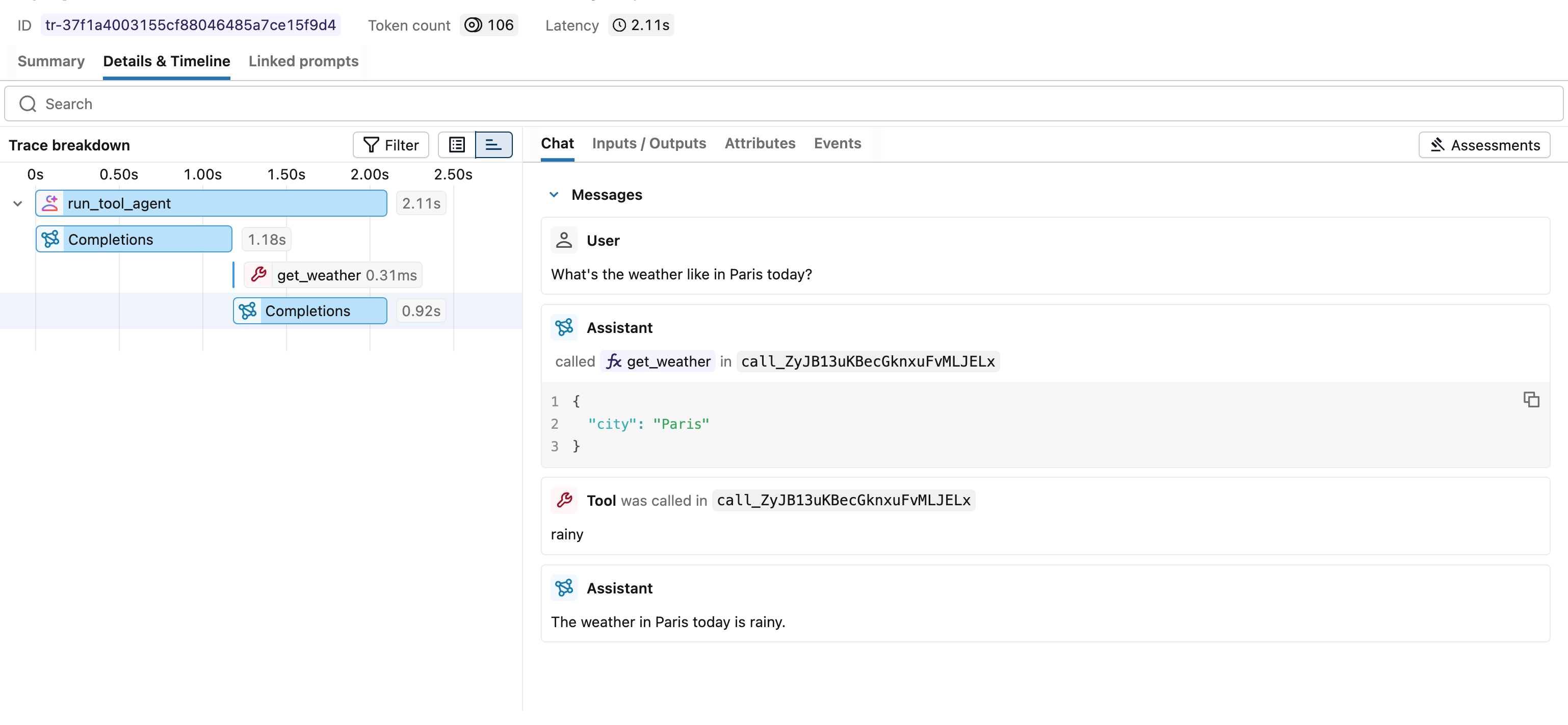
Deze handleiding laat zien hoe je **Novita AI** integreert met MLflow Tracing. Door Novita AI's OpenAI-compatibele endpoint (`https://api.novita.ai/openai`) te gebruiken, kun je prompts, antwoorden, latentie, tokengebruik en modelmetadata vastleggen in MLflow.
 # Vereisten
Voordat je begint, zorg ervoor dat je het volgende hebt:
* Novita AI API-sleutel: maak er een aan in [Key Management](https://novita.ai/settings/key-management).
* Een draaiende MLflow-trackingserver. Je kunt de lokale standaard `http://localhost:5000` gebruiken.
* Python- of JavaScript-runtime.
# Integratiestappen
## Stap 1: Installeer afhankelijkheden
```bash Python icon="python" theme={"system"}
pip install 'mlflow[genai]' openai
```
```bash JavaScript / TypeScript icon="js" theme={"system"}
npm install @mlflow/openai openai
```
## Stap 2: Start de MLflow-server
Als je een lokale Python-omgeving >= 3.10 hebt, kun je MLflow starten met:
```bash theme={"system"}
mlflow server
```
MLflow biedt ook een Docker Compose-configuratie:
```bash theme={"system"}
git clone --depth 1 --filter=blob:none --sparse https://github.com/mlflow/mlflow.git
cd mlflow
git sparse-checkout set docker-compose
cd docker-compose
cp .env.dev.example .env
docker compose up -d
```
Open vervolgens `http://localhost:5000` om te bevestigen dat de MLflow-UI toegankelijk is.
## Stap 3: Schakel tracing in en roep Novita AI aan
```python Python icon="python" theme={"system"}
import openai
import mlflow
# Enable auto-tracing for OpenAI-compatible calls
mlflow.openai.autolog()
# Optional: set tracking target and experiment
mlflow.set_tracking_uri("http://localhost:5000")
mlflow.set_experiment("Novita AI")
client = openai.OpenAI(
base_url="https://api.novita.ai/openai",
api_key="",
)
response = client.chat.completions.create(
model="deepseek/deepseek-r1",
messages=[
{"role": "system", "content": "You are a helpful assistant."},
{"role": "user", "content": "What is the capital of France?"},
],
)
print(response.choices[0].message.content)
```
```ts JavaScript / TypeScript icon="js" theme={"system"}
import { OpenAI } from "openai";
import { tracedOpenAI } from "@mlflow/openai";
const client = tracedOpenAI(
new OpenAI({
baseURL: "https://api.novita.ai/openai",
apiKey: "",
})
);
const response = await client.chat.completions.create({
model: "deepseek/deepseek-r1",
messages: [
{ role: "system", content: "You are a helpful assistant." },
{ role: "user", content: "What is the capital of France?" },
],
temperature: 0.1,
max_tokens: 100,
});
console.log(response.choices[0].message?.content);
```
## Stap 4: Bekijk traces in de MLflow-UI
Open je MLflow-UI (bijvoorbeeld `http://localhost:5000`) en ga naar je geconfigureerde experiment om traces te inspecteren.
Je zou het volgende moeten zien:
* Prompt- en completion-inhoud
* Latentie en tokengebruik
* Model- en aanvraagmetadata
* Fouten/exceptions (indien aanwezig)
## Stap 5: Geavanceerde tracing-referenties
### Streaming en async
MLflow ondersteunt tracing voor streaming en async Novita AI-API's. Zie:
* [OpenAI Tracing](https://mlflow.org/docs/latest/genai/tracing/integrations/listing/openai/)
### Combineren met frameworks of handmatige tracing
```python Python icon="python" theme={"system"}
import json
from openai import OpenAI
import mlflow
from mlflow.entities import SpanType
# Initialize the OpenAI client with Novita AI API endpoint
client = OpenAI(
base_url="https://api.novita.ai/openai",
api_key="",
)
# Create a parent span for the Novita AI call
@mlflow.trace(span_type=SpanType.CHAIN)
def answer_question(question: str):
messages = [{"role": "user", "content": question}]
response = client.chat.completions.create(
model="deepseek/deepseek-r1",
messages=messages,
)
# Attach session/user metadata to the trace
mlflow.update_current_trace(
metadata={
"mlflow.trace.session": "session-12345",
"mlflow.trace.user": "user-a",
}
)
return response.choices[0].message.content
answer = answer_question("What is the capital of France?")
```
```ts JavaScript / TypeScript icon="js" theme={"system"}
import * as mlflow from "@mlflow/core";
import { OpenAI } from "openai";
import { tracedOpenAI } from "@mlflow/openai";
mlflow.init({
trackingUri: "http://localhost:5000",
experimentId: "",
});
// Wrap the OpenAI client and point to Novita AI endpoint
const client = tracedOpenAI(
new OpenAI({
baseURL: "https://api.novita.ai/openai",
apiKey: "",
})
);
// Create a traced function that wraps the Novita AI call
const answerQuestion = mlflow.trace(
async (question: string) => {
const resp = await client.chat.completions.create({
model: "deepseek/deepseek-r1",
messages: [{ role: "user", content: question }],
});
return resp.choices[0].message?.content;
},
{ name: "answer-question" }
);
await answerQuestion("What is the capital of France?");
```
Voor de volledige upstream-referentie:
* MLflow Novita AI-integratiepagina: [Tracing Novita AI](https://mlflow.org/docs/latest/genai/tracing/integrations/listing/novitaai/)
* MLflow OpenAI-tracingdocumentatie: [OpenAI Tracing](https://mlflow.org/docs/latest/genai/tracing/integrations/listing/openai/)
Voor Novita-modeldetails en endpointgebruik, zie:
* Novita LLM API-handleiding: [LLM API](/docs/nl/guides/llm-api)
# Vereisten
Voordat je begint, zorg ervoor dat je het volgende hebt:
* Novita AI API-sleutel: maak er een aan in [Key Management](https://novita.ai/settings/key-management).
* Een draaiende MLflow-trackingserver. Je kunt de lokale standaard `http://localhost:5000` gebruiken.
* Python- of JavaScript-runtime.
# Integratiestappen
## Stap 1: Installeer afhankelijkheden
```bash Python icon="python" theme={"system"}
pip install 'mlflow[genai]' openai
```
```bash JavaScript / TypeScript icon="js" theme={"system"}
npm install @mlflow/openai openai
```
## Stap 2: Start de MLflow-server
Als je een lokale Python-omgeving >= 3.10 hebt, kun je MLflow starten met:
```bash theme={"system"}
mlflow server
```
MLflow biedt ook een Docker Compose-configuratie:
```bash theme={"system"}
git clone --depth 1 --filter=blob:none --sparse https://github.com/mlflow/mlflow.git
cd mlflow
git sparse-checkout set docker-compose
cd docker-compose
cp .env.dev.example .env
docker compose up -d
```
Open vervolgens `http://localhost:5000` om te bevestigen dat de MLflow-UI toegankelijk is.
## Stap 3: Schakel tracing in en roep Novita AI aan
```python Python icon="python" theme={"system"}
import openai
import mlflow
# Enable auto-tracing for OpenAI-compatible calls
mlflow.openai.autolog()
# Optional: set tracking target and experiment
mlflow.set_tracking_uri("http://localhost:5000")
mlflow.set_experiment("Novita AI")
client = openai.OpenAI(
base_url="https://api.novita.ai/openai",
api_key="",
)
response = client.chat.completions.create(
model="deepseek/deepseek-r1",
messages=[
{"role": "system", "content": "You are a helpful assistant."},
{"role": "user", "content": "What is the capital of France?"},
],
)
print(response.choices[0].message.content)
```
```ts JavaScript / TypeScript icon="js" theme={"system"}
import { OpenAI } from "openai";
import { tracedOpenAI } from "@mlflow/openai";
const client = tracedOpenAI(
new OpenAI({
baseURL: "https://api.novita.ai/openai",
apiKey: "",
})
);
const response = await client.chat.completions.create({
model: "deepseek/deepseek-r1",
messages: [
{ role: "system", content: "You are a helpful assistant." },
{ role: "user", content: "What is the capital of France?" },
],
temperature: 0.1,
max_tokens: 100,
});
console.log(response.choices[0].message?.content);
```
## Stap 4: Bekijk traces in de MLflow-UI
Open je MLflow-UI (bijvoorbeeld `http://localhost:5000`) en ga naar je geconfigureerde experiment om traces te inspecteren.
Je zou het volgende moeten zien:
* Prompt- en completion-inhoud
* Latentie en tokengebruik
* Model- en aanvraagmetadata
* Fouten/exceptions (indien aanwezig)
## Stap 5: Geavanceerde tracing-referenties
### Streaming en async
MLflow ondersteunt tracing voor streaming en async Novita AI-API's. Zie:
* [OpenAI Tracing](https://mlflow.org/docs/latest/genai/tracing/integrations/listing/openai/)
### Combineren met frameworks of handmatige tracing
```python Python icon="python" theme={"system"}
import json
from openai import OpenAI
import mlflow
from mlflow.entities import SpanType
# Initialize the OpenAI client with Novita AI API endpoint
client = OpenAI(
base_url="https://api.novita.ai/openai",
api_key="",
)
# Create a parent span for the Novita AI call
@mlflow.trace(span_type=SpanType.CHAIN)
def answer_question(question: str):
messages = [{"role": "user", "content": question}]
response = client.chat.completions.create(
model="deepseek/deepseek-r1",
messages=messages,
)
# Attach session/user metadata to the trace
mlflow.update_current_trace(
metadata={
"mlflow.trace.session": "session-12345",
"mlflow.trace.user": "user-a",
}
)
return response.choices[0].message.content
answer = answer_question("What is the capital of France?")
```
```ts JavaScript / TypeScript icon="js" theme={"system"}
import * as mlflow from "@mlflow/core";
import { OpenAI } from "openai";
import { tracedOpenAI } from "@mlflow/openai";
mlflow.init({
trackingUri: "http://localhost:5000",
experimentId: "",
});
// Wrap the OpenAI client and point to Novita AI endpoint
const client = tracedOpenAI(
new OpenAI({
baseURL: "https://api.novita.ai/openai",
apiKey: "",
})
);
// Create a traced function that wraps the Novita AI call
const answerQuestion = mlflow.trace(
async (question: string) => {
const resp = await client.chat.completions.create({
model: "deepseek/deepseek-r1",
messages: [{ role: "user", content: question }],
});
return resp.choices[0].message?.content;
},
{ name: "answer-question" }
);
await answerQuestion("What is the capital of France?");
```
Voor de volledige upstream-referentie:
* MLflow Novita AI-integratiepagina: [Tracing Novita AI](https://mlflow.org/docs/latest/genai/tracing/integrations/listing/novitaai/)
* MLflow OpenAI-tracingdocumentatie: [OpenAI Tracing](https://mlflow.org/docs/latest/genai/tracing/integrations/listing/openai/)
Voor Novita-modeldetails en endpointgebruik, zie:
* Novita LLM API-handleiding: [LLM API](/docs/nl/guides/llm-api)